Angular
Distance of the Nearest Neighbor
The applet
is computing the angular separation (degrees) of the nearest neighbor
for 200 of the brightest stars (visual magnitudes < 3.0):
The stars are displayed by two frames:
- a right ascension - declination chart,
the angular distance seen at the sky is distorded for high declinations,
- a spherical sky chart of the local horizon.
The
number
of
stars
of
visual
magnitude<3
above
horizon
(while
Sun
elevation<-12°)
is
between
63
and
83.
number of
stars
|
visual
magnitude
|
next
neighbor
mean distance
|
| 30 |
<= 1.73 |
16.5° |
60
|
<= 2.09 |
12.4° |
| 120 |
<= 2.68 |
8.65° |
| 180 |
<= 3.02
|
7.2° |
| 240 |
<= 3.32 |
6.6° |
Splitting
the
celestial
sphere
(size
3602/π
square
degrees
=
41253
square
degrees) into
equal-sized cells (d*d square degrees each)
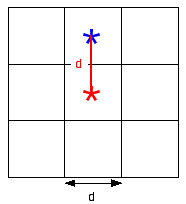
and
supposing
that
a
star
and
its
nearest
neighbor
occupy
9
cells
(9/2
cells
per
star),
the
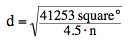
mean angular distance d of n stars is
distance for
number of stars
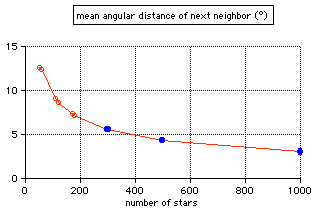
n>240 computed by the formula
Between
n=60 and
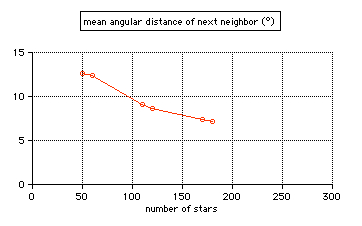
n=240 the mean difference between the observed angular
distance (applet) of the nearest neighbor and the value from the
formula is 1.7 %.
number of
stars
|
visual
magnitude
|
next
neighbor
mean distance
|
next
neighbor
mean distance
by formula
|
| 30 |
< 1.73 |
16.50° |
17.48° |
60
|
< 2.09 |
12.43° |
12.36° |
| 120 |
< 2.68 |
8.65° |
8.74° |
| 200 |
< 3.16
|
7.11° |
6.77° |
| 240 |
< 3.32 |
6.46°
|
6.56° |
| 500 |
< 4.0 |
-
|
4.3° |
| 1000 |
< 4.6 |
-
|
3.0° |
visual magnitude
|
number of stars
brighter than
|
-1
|
1 |
| 0 |
4 |
| 1 |
15 |
| 2 |
48 |
| 3 |
171 |
| 4 |
513 |
| 5 |
1602 |
| 6 |
4800 |
| 7 |
14,000 |
8
|
42,000 |
| 9 |
121,000 |
| 10 |
340,000
|
|