from 1,000,000 BC to 1,000,000 AD
Variations for 4,000 BC to 8,000 AD
According to Meeus (More
Mathematical Astronomy Morsels, Chapter 33)
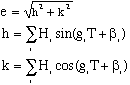
Bretagnon published in 1984 an algorithm for the
eccentricity e valid for a very long period of
time: The time T is expressed in thousands of
years from the epoch 1850.0. The sums h and k have
19 terms of coefficients Hi, gi,
and βi. This method gives good results from
1,000,000 BC to 1,000,000 AD.
Compute the eccentricity by JavaScript:
Write a table by JavaScript:
|
|
The Earth's orbital eccentricity changes with a period of about 100,000 years in the range of to 0.06:
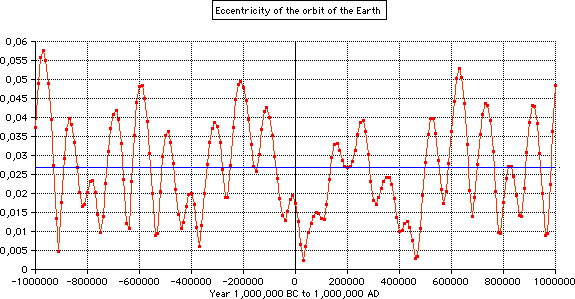
The mean value of the eccentricity is 0,02674, the present value is 0.01670.
The perihelon distance dP for
an ellipse of semimajor axis a and eccentricity e
is: dP / a = 1 - e The amount of solar radiation S received
by the Earth (
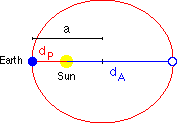
 "insolation") is proportional to the square of the
inverse:
"insolation") is proportional to the square of the
inverse:
dP/a = 1 - e
S / S2000
from 2000
dA/a = 1 + e
S / S2000
from 2000
Perihelion Aphelion The difference of the insolation at
perihelion and at aphelion is 7 % at present, and
17 % for the maximum eccentricity.
For the minimum value of the eccentricity e the
amount of solar radiation received by the Earth
(insolation) is 3 % less than at present, and for
the maximum value of e the radiation is 9 %
greater than at present.
For the minimum value of the eccentricity e the
amount of solar radiation received by the Earth
(insolation) is 3 % greater than at present, and
for the maximum value of e the radiation is 8 %
less.
Variations for 4,000 BC to 8,000 AD
(c) 2006-2018 J. Giesen
2019, May 17