|
|
 GeoAstro Applets |
 Astronomy |
 Chaos Game |
 Java |
 Miscel- laneous |
 Physics Quiz |
 Who is Who ? |
Kepler's Mysterium Cosmographicum
Solving Kepler's equation of elliptical motion
Movie of elliptical motion
Plots of elliptical Kepler motion
The circumference of an ellipse
Kepler's third law
Mars
Kepler Applet
This applet is simulating the elliptical motion of a celestial body.
Use the third scrollbar (blue) to
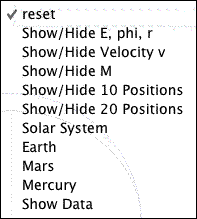
increase uniformly the true anomaly angle phi. Select from the menu for
details, such as eccentric anomaly. radius,
velocity.
Use the fourth scrollbar (red) to increase
uniformly the time (mean anomaly M).
|
|
|
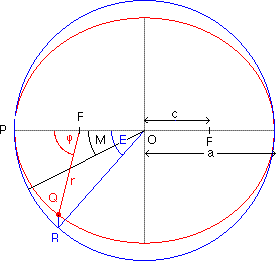
The mean anomaly M is the angular
distance from perihelion which a (fictitious)
planet would have if it moved on the circle of
radius a with a constant angular velocity
and with the same orbital period T as the real
planet moving on the ellipse. By definition, M
increases linearly (uniformly) with time. Choose Show/Hide Velocity v and
Show/Hide Vel. Circle: Applet for Mars
As the planet P is moving around the ellipse, the
end of the velocity vector OP' will move around
the gray circle (center M), and FP is always
pependicular to to MP'. 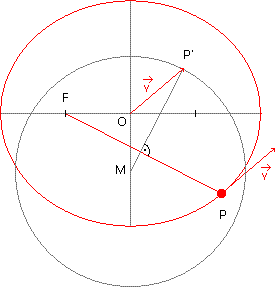
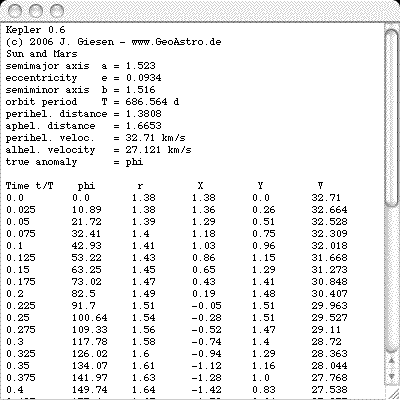
The data window of the applet:
Solving Kepler's equation of elliptical motion
E - e*sin(E) = M(t)
Eccentricity of the orbit of the Earth (long-period variations)
|
|
|
Solution for the motion as a function of time (Wikipedia) Kepler's Equation of Elliptical Motion Kepler's Equation for Elliptical Motion, a Numerical Solution Utility |
Updated: 2017, May 02